
How Wilson Residents Are Found
Wilson has no single official list of everyone who lives in town. The useful path depends on the question. An owner name or street address belongs first in the Wilson County wEdge property search. A registration question belongs in the North Carolina voter lookup. A transfer history belongs in the Register of Deeds guest index. A person who lived here decades ago may be easier to place through a library directory, newspaper, obituary, or estate file. Each source has a date and a purpose, so an owner, an old directory household, and a voter entry should be treated as separate pieces of evidence.
Begin with the most concrete detail available. Keep the spelling, street direction, suffix, approximate date, and any book/page number together. The property roll can identify an owner of record and a parcel, but it does not prove who occupies a building. A voter entry can help distinguish a name, but protected addresses are withheld. A missing result also proves little: a person may be a renter, use a different spelling, appear in an older collection, or fall within a restricted record class.
- Search wEdge by owner name, property number, or address. Save the parcel number, physical address, taxpayer mailing address, legal description, and recorded deed reference.
- Use the voter lookup with a first and last name, then add Wilson County and year of birth when needed to separate similar names.
- Open the Register of Deeds index with a parcel, party name, or book/page reference, then read the deed image rather than relying only on a result row.
- For an earlier household, compare the closest Hill directory year, its street guide, the Wilson Times material, and the released federal census schedule.
- When the needed existing record is not online, ask the actual custodian for a narrow name, address, date range, or book/page request under North Carolina Public Records Law.
Wilson Offices Behind Resident Records
Wilson and Wilson County have different custodians. The city routes permits, code cases, council records, and city-held police material through its Clerk, while the county holds tax cards, deeds, and local vital records. The Clerk of Superior Court holds court, estate, and divorce files. The elections office works with the state system. This division matters because North Carolina Public Records Law gives access to existing records held by the proper office, not a right to have an office build a new household list. Address-by-address work is developed further on the Wilson streets page.
Wilson County Register of Deeds
101 N Goldsboro St
Wilson, NC 27893
252-399-2935
Wilson County Tax Department
County tax and assessment records
Wilson County, NC
Public web search
Wilson Property Roll Name Searches
The county’s wEdge screen accepts one value labeled Property Number, Owner Name, or Address. Results can be filtered by real estate, personal property, special personal property, payment status, and retired rows. A selected parcel card can include the owner, legal description, neighborhood, physical address, taxpayer mailing address, acres, plat reference, sales history, tax values, improvements, and permit/date notes. It is a tax and assessment record. It is not a certified deed, and a taxpayer mailing address may be an office, agent, PO box, or an address outside the parcel.
The wEdge quick search is therefore a strong way to anchor a Wilson name to a parcel. The physical, also called situs, address tells where the property lies. The mailing address tells where notices go. Save both, then use the parcel’s book/page reference for a recorded instrument. The advanced form has value, acreage, sale, municipality, neighborhood, class, and tax-year filters, but the inspected form does not show a ZIP field.
| Property search field | Wilson use |
|---|---|
| Property Number, Owner Name, or Address | Starts a parcel, owner, or street inquiry. |
| Search All Tax Years | Includes portal years available, with no stated complete year range. |
| Municipalities and Neighborhoods | Narrows assessment geography, not a complete resident list. |
| Sale Date and Price ranges | Finds transaction candidates that still need deed-image review. |
Note: A tax card identifies an owner of record, not every person who lives at a Wilson address.
Wilson GIS Links Addresses to Parcels
Wilson County GIS separates Parcel Search from Address or Street Search. The user guide says the address search uses address points, while ownership and tax information come from Identify on the Tax Parcels layer. Search one box at a time, select a result in the Results tab, and use the map to inspect the parcel. Layers can add streets, parcels, aerial or historical photography, topography, utilities, and public districts. The Download area links to Addresses, Tax Parcels, Streets, and county open data.
The parcel layer can expose GISPIN, parcel number, owner fields, physical street parts, taxpayer address parts, deed book/page, sale information, legal descriptions, plat references, value fields, tax year, district, and geometry. Those are useful discovery fields. The county and city both caution that GIS mapping is informational rather than survey-quality. Title and legal boundaries remain matters for the recorded deed and plat.
Wilson Deed Index Names and Images
The Wilson Register of Deeds guest portal supports parcel, name/index, book/page, file-date, instrument-kind, grantor, grantee, description, file number, reference, amount, and image searches after guest entry. The county says its online real-estate indexes begin in 1974. The portal also displays a 1946 through 1973 date-range notice, but older results can carry January 1 placeholder dates. Treat that display as a lead and confirm the exact recording information in the image or book.
Grantor means the party transferring an interest, while grantee means the party receiving one. A recorded deed can connect parties, a parcel, a legal description, a book/page, and an instrument date. It does not say who presently occupies a building. When a result gives an image count, open the images and compare the lot, block, subdivision, metes-and-bounds description, and prior reference before connecting two similar Wilson names.
Wilson’s property search screen is shown below. It is the practical first stop when the starting fact is an owner name or an address.
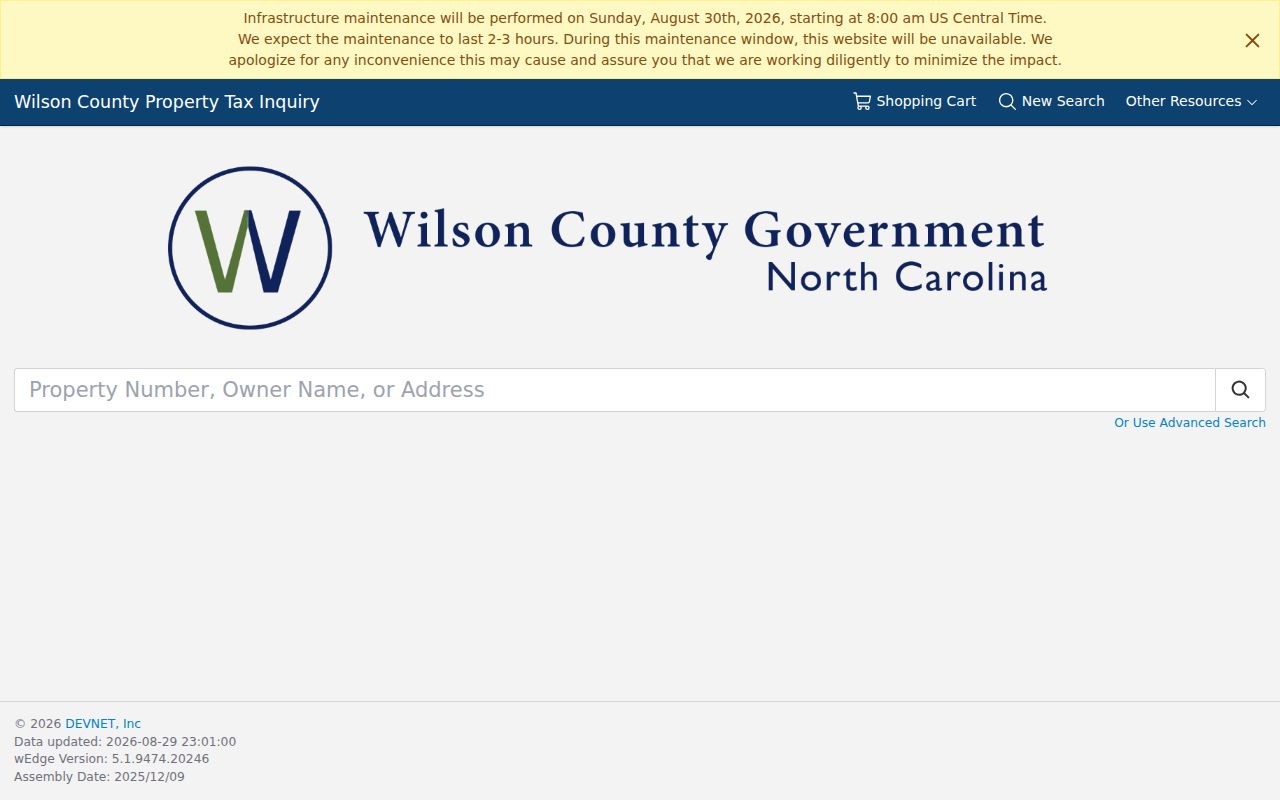
The single quick-search box is why it helps to keep the full street direction, suffix, parcel number, or owner spelling with the search notes.
Wilson Voter Records and Their Limits
North Carolina’s voter lookup requires a first and last name. A middle initial, year of birth, and county are optional, and at least one status choice must be selected: Registered, Removed, or Denied. A matching record can provide jurisdictions, polling place information, a sample ballot when available, absentee information, and voter history. It is not a general person-history report, and a non-match may reflect a spelling, status, move, recent change, protection, or a search choice.
Most voter-registration information is public under N.C.G.S. § 163-82.10 and Chapter 132. Full dates of birth, SSNs, driver-license numbers, agency-of-registration identity, military or overseas email, and protected addresses are not public. The state also offers current and historical downloadable files, but a request should ask for an existing file with a county, precinct, status, or date range rather than for a newly compiled list.
Wilson Court Party Records
When the question is about a public case, use the North Carolina eCourts Portal or the Wilson County Clerk of Superior Court, not the property roll. Smart Search accepts case number, party name, business name, date of birth, county or location, case type, case status, and filing-date range. Hearing and judgment searches add their own fields. The public portal does not require registration, but it is a party-and-case index, not a general name-history service.
Use the county field and a second fact to separate similar names. The official search rules require at least three last-name characters plus an asterisk for a partial last-name search, at least one first-name character plus an asterisk, and four case-number characters plus an asterisk for a partial case search. A public result can lead to case summary, parties, filing date, events, hearings, disposition, and related financial information when applicable. Juvenile, sealed, expunged, and other confidential material remains unavailable.
For a public file that cannot be resolved online, take the case number, party names, case type, and approximate filing date to the Clerk. Public self-service terminals can search public criminal cases by defendant, case number, or victim or witness name, and the Clerk retains paper files for its county. Ask for inspection, an ordinary copy, or a certified copy as needed. Note: The Judicial Branch says its central public-record route is not the custodian of individual court documents.
Wilson Vital Records by Event
Birth, death, marriage, and divorce questions need the right office and the right type of copy. The Wilson County Register of Deeds vital-record route lists county marriage records from 1855 forward and birth and death records from 1913 forward. The local office issues records filed in the county, while NC Vital Records provides statewide ordering for birth records from 1913, death records from 1930, marriage records from 1962, and divorce certificates from 1958.
Certified copies are eligibility-limited. Wilson's local instructions describe a valid government ID, relationship or legal-interest rules, and a $10 certified-copy charge; the online ordering route also lists $1 uncertified copies plus card fees. An uncertified copy may be available where law permits, but a record does not become unrestricted merely because it is old. North Carolina protects specified birth information under N.C.G.S. § 130A-93, while divorce case files belong with the Wilson Clerk rather than the vital-certificate office.
Wilson's Register of Deeds also posted a current Senate Bill 248 notice: from January 1, 2026, an adopted person born in Wilson County may request a new birth certificate in person from the local office. That route is specific and time-sensitive, so the office's current instructions should be checked before a visit.
Wilson Library and Archive Trails
The Wilson County Public Library Local History Room is the main local fallback when an online index stops. It is open during main-library hours, and research appointments are recommended at 252-237-5355 ext. 5029. Its listed resources include in-library Ancestry Library Edition, Newspaper Archive with the Wilson Times Digital Archive, Fold3, Heritage Hub, microfilm, and local digital exhibits. Ask specifically for city directories, telephone books, yearbooks, obituary indexes, funeral-home material, and old street guides.
The North Carolina Archives government-record collection adds older county land, court, estate, tax, marriage, and will records, with box lists and a copy-request route. The Archive is especially important before Wilson County existed. Wilson was created in 1855 from Edgecombe, Nash, Johnston, and Wayne counties, so an earlier resident trail may be filed in one of those parent counties rather than under Wilson.
North Carolina Archives county holdings are shown below. Their county-series finding aids are a practical bridge when a deed book, estate file, or tax record is older than the online tools.

Use the county name, record series, date range, and a name or book reference in a copy request. The Archives can locate existing material, but it does not turn an uncertain name into a completed resident profile.
Wilson Records Have Privacy Boundaries
North Carolina Public Records Law, Chapter 132, provides a right to inspect existing public records at reasonable times and to receive copies as promptly as possible after lawful fees. It does not require a custodian to create a new list or compile a dossier. Narrow requests work best: identify the office, existing record type, name or address, time period, and any case, parcel, book, or page reference. The City Clerk is the proper route for city permits, code cases, council material, and city-held police records, while county deeds, tax cards, courts, and local vital records have their own custodians.
Public access has real limits. Protected voter addresses, full Social Security and driver-license numbers, full dates of birth, utility-account information, juvenile matters, adoption material, sealed cases, and sensitive investigative records are not open simply because a name or address is known. North Carolina Safe at Home protections under Chapter 15C can substitute a protected address in public voter material. A public map or index is not a household roster.
Lawful use. Wilson records are useful for family history, estate work, civic research, and reconnecting, but never for stalking, harassment, intimidation, or harm.
Current Wilson Resident Directory Sources
Current Wilson resident information is distributed across public systems rather than published as a single directory. The records below answer different questions. Property and deeds document ownership or a transaction. The election system documents registration subject to statutory protections. Court and vital-record tools have their own purpose and confidentiality rules. Historic directories, newspapers, and library collections often offer the most useful context for a former resident. Use two independent anchors, such as an address plus spouse, a legal description plus parcel, or a case number plus year, before treating a name match as the same person.
| Source | Who It Lists | Keeper | Access |
|---|---|---|---|
| wEdge tax roll | Owners of record and parcel details | Wilson County Tax Department | Public online search |
| NC voter lookup | Registration status and jurisdiction | NC State Board of Elections | Public form with redactions |
| ROD land index | Parties to recorded land instruments | Wilson County Register of Deeds | Guest index and office route |
| eCourts Portal | Public case parties and docket data | North Carolina Judicial Branch | Public index, restrictions apply |
| City neighborhood pages | Public group names and contact route | City Human Relations | No member rosters located |
Official rolls and commercial directory products are not interchangeable. A Wilson search should begin with a named custodian because the record's purpose and limits are visible. A commercial result can be a lead, but it needs checking against the public source that actually created the record.
| Source type | Useful for | Wilson caution |
|---|---|---|
| Official index or record | A parcel, deed party, voter-registration status, court case, or dated directory entry | It is tied to a custodian and a specific purpose, but may be redacted, incomplete, or outside the needed date range. |
| Commercial people-search service | A possible spelling, past address, or starting lead | Its source, update cycle, coverage, and identity match may be unclear. Confirm any result through the Wilson or North Carolina custodian. |
Use property records for an owner question and a deed image for the transaction behind it. Use a voter record for election status, not as an occupancy guarantee. The Wilson resident lookup workflow sets out how to verify one person across those distinct systems. City neighborhood association pages name public groups and meeting routes, but the research did not locate association member rosters.
Historical Wilson Resident Directories
Wilson's verified digitized Hill directory run includes 1908–09, 1912–13, 1916–17, 1922–23, 1925, 1930, 1941, 1947–48, 1950, and 1959. The scans are cataloged through DigitalNC with UNC and Duke holding metadata, and the Local History Room can help identify physical volumes or related materials. The run has gaps, and the research did not establish a final printed year, so absence from a single volume is not proof that a household was absent.
Read the alphabetical listing with its street guide and the abbreviation key. A city directory can preserve a name, address, occupation, business, or spouse notation, while a telephone book reaches subscribers only. For a full account of the collections and a household-through-time method, use the Wilson city directory collections. Match any old address to a deed legal description or a map before assuming modern numbering is identical.
- Roll
- A record created for one purpose, such as taxes or registration, rather than a complete live-resident list.
- Index
- A finding tool that points to a record; the image or file may hold the needed context.
- Parcel
- A mapped unit of land with a county identifier, distinct from the people who may use the address.
- Criss-cross directory
- An address-arranged directory used to read historical street sequence.